Treatment options, time, and hope for one family's "chief memory maker"
[5 min read]
In this article:
- Meet Virginia Kuo, a busy wife and mother with three young children who was diagnosed with stage 4 lung cancer.
- In recent years the number of non-smoker patients with lung cancer, like Kuo, has been increasing.
- Providence Swedish Cancer Institute researchers are at the fore of promising clinical trials and research projects to give our patients with lung cancer the first opportunity to access new medications and therapies.
- Learn more about Virginia Kuo's story how generous donors to the Swedish Foundation make life-changing research possible.
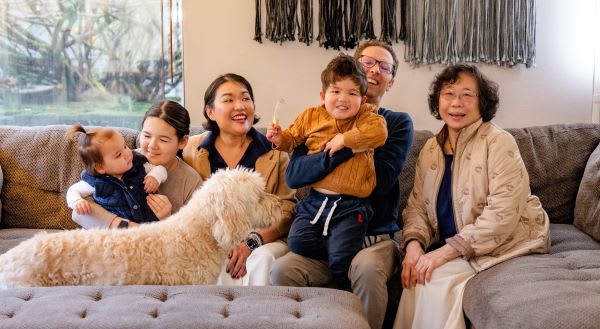
In early 2025, Virginia Kuo’s life was busy in the best way. As an HR leader at Amazon and the “Chief Memory Maker” for her children ages 11, 3, and 1, she had a full, fulfilling schedule. But then one Saturday in May, everything came to a halt. Virginia woke up feeling like there was a dumbbell on her chest. She went to urgent care but, after a concerning chest X-ray, was transferred to the emergency department at Providence Swedish Edmonds. More scans and tests revealed Virginia had a mass in her lung and lesions on her spine and ribs.
“I was pretty cool up until that moment,” she recalls, “but then I just started crying.”
Virginia and her husband Lytton later met with Perrin Romine, M.D., an oncologist at Providence Swedish Edmonds. After a biopsy, they learned she had stage 4 lung cancer fueled by two specific gene mutations: EGFR (epidermal growth factor receptor), which is the most common type of mutation for patients who aren’t smokers, and TP53, often associated with more aggressive cancers.
“That first appointment with Dr. Romine was really difficult, but her message to stay hopeful was heard,” Virginia says. “She told me, ‘There’s treatment available, there’s something we can do.’”
Philanthropy powers new potential treatments
At Providence Swedish Cancer Institute, exploring every treatment option for patients like Virginia is made possible thanks to philanthropy. Support from the community helps fuel promising clinical trials and research projects, giving Providence Swedish patients the first opportunity to access new medications and therapies.
“For patients who should be considered for clinical trials, we do everything we can to get them in as soon as possible,” Dr. Romine says.
For Virginia, this meant starting with a course of palliative radiation and reviewing several clinical trials she qualified for, including one run by Sid Devarakonda, M.D., who spearheads the thoracic oncology clinical and research program at Providence Swedish Cancer Institute. His team’s trial takes a combination drug approach, pairing a standard-of-care oral medication with a new type of chemo that’s meant to have fewer side effects. 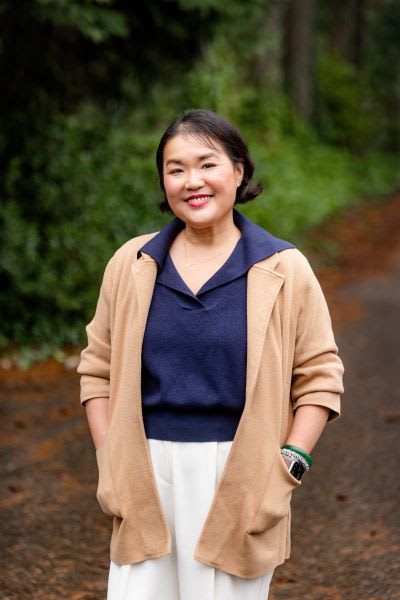
“During my first consult with Dr. Devarakonda, I asked him how he’s going to prioritize me, Virginia, versus his study,” Virginia says. “His response made me feel like he saw me as a person, a human dealing with something terrible. I felt like he would be my doctor, not the researcher of a clinical trial.”
Treating each individual, not just their disease
“In our research, we are really focused on understanding why never-smokers get lung cancer,” says Dr. Devarakonda. “Why are rates going up and what drives the cancer? We’re also interested in understanding how treatment resistance emerges.”
For Virginia, Dr. Devarakonda and his team prioritized getting her stabilized. Her first set of scans after starting the trial were “beautiful.” The tumor in her lung had shrunk, and there was evidence that the tumors were receding from her bones and shrinking in her liver.
But then, in mid-August, Virginia started having difficulty breathing. She was in the rare 2 percent of patients who developed a potentially life-threatening inflammation of the lungs called pneumonitis and had to immediately pull out of the trial.
Today, Dr. Romine’s team and Virginia are evaluating the next step, figuring out how to balance her ongoing treatment while also minimizing the impact on her family. Dr. Devarakonda and his team still remain in communication as well, reviewing scans and discussing options as needed.
“She’s a mom to young kids, and we want to make sure she’s able to have the family life and be the mother and wife that she wants to be,” Dr. Romine says. “My job as someone who practices in this community is making sure I’m getting the patient where they need to be as quickly as possible.”
For that, Virginia says she's continually grateful. She’s taking things day by day, focusing on making memories with her family and, of course, never giving up hope.
“I’m trying to figure out how to live this life now,” she says. “Nine percent of people who have my type of cancer make it past five years, but as unlucky as I’ve been every step of the way, hopefully I will be on the other side of those odds.”
The rise of lung cancer in non-smokers
Lung cancer is the third-most common cancer in the United States and, traditionally, was driven by cigarette use or exposure to secondhand smoke. In recent years, though, the number of non-smoker patients who develop lung cancer is on the rise. It’s part of a troubling trend that largely impacts younger women of Asian descent, like Virginia Kuo.
Many clinical trials and research endeavors at Providence Swedish are funded by philanthropy, including a new tissue and blood archive being created by Sid Devarakonda, M.D., medical director of the thoracic oncology clinical and research program at Providence Swedish Cancer Institute.
Thanks to the generosity of donors and a grant from the Kuni Foundation, which supports the exploration of research that can translate into breakthrough treatments, improved outcomes for underserved communities, and affordable therapeutic approaches, Dr. Devarakonda’s team hopes to create a resource of more than 100 lung cancer tissue and blood samples.
This archive of samples can then be used to better understand why non-smokers are getting lung cancer at higher rates, what drives this type of cancer, and how treatment resistance emerges.
Learn more and find a physician or advanced practice clinician (APC)
If you or a loved one have questions about cancer diagnosis, treatment or care, the experts at the Providence Swedish Cancer Institute are here for you. We can accommodate both in-person and virtual visits. To talk to someone or make an appointment, call 1-855-XCANCER.
You can also learn more about available clinical trials. Our physician investigators and researchers are involved in hundreds of ongoing trials involving most types of cancer.
Whether you require an in-person visit or want to consult a doctor virtually, you have options. Swedish Virtual Care connects you face-to-face with a nurse practitioner who can review your symptoms, provide instruction and follow up as needed. If you need to find a doctor, you can use our provider directory.
About the Swedish Foundation
Your generous gift helps support a healthy tomorrow for everyone in every community we serve. Learn about more ways to give to the Swedish Foundation or make a direct donation online at swedishfoundation.org. You can also contact the Foundation at 206-368-2738 or email foundation@swedish.org. Thank you for helping us shape the future of health care. We can’t do it without you.
Additional resources
Small cell and non-small cell lung cancer: What you should know.
Providence Swedish researchers receive grant to explore new frontier of precision oncology
Providence Swedish is revolutionizing lung cancer care with robotic bronchoscopy
Harnessing the power of the body’s own immune system to treat (and defeat) cancer
Melanoma is a common cancer. Learn about signs and treatments.
This information is not intended as a substitute for professional medical care. Always follow your health care professional's instructions.
The Providence app offers world-class health care with human connection
Follow us on Facebook, Instagram and X.