Is a C-section the right choice for you?
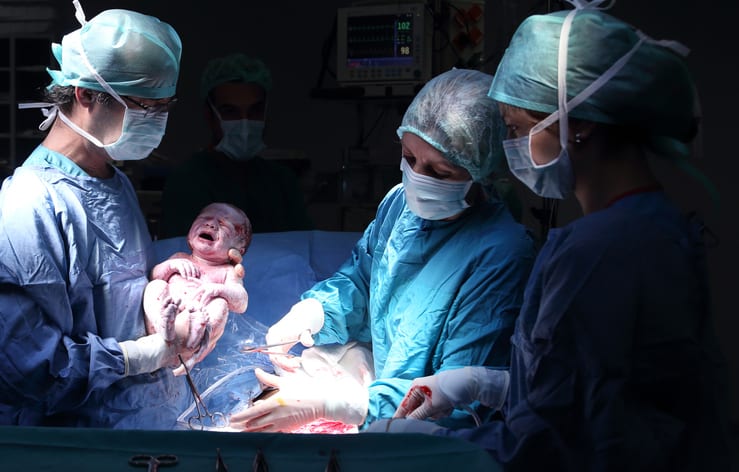
[5 min read]
In this article:
- Nearly 1.2 million babies arrive by Cesarean section every year in the United States.
- The procedure is safe and common, but not always necessary. Providence Swedish's TeamBirth initiative and JUST Birth Network have helped reduce C-sections among Black, Indigenous and POC mothers to less than 25%.
- A Providence Swedish obstetrician and maternal and fetal medicine expert discusses the C-section procedure, along with how care teams and parents decide when they're necessary and what to expect after.
When it comes to childbirth, most people prepare for a traditional vaginal delivery; first-time parents attend childbirth classes and make birth plans centered on that way of birth. However, in some cases Cesarean sections (C-sections) become a significant part of the birth story.
Katherine Eastwood, M.D., a maternal and fetal medicine specialist and obstetrician specializing in high-risk pregnancies at Providence Swedish shared more recently about the procedure and what moms should know about it during and after birth.
“A C-section is a surgical procedure where instead of delivering the baby vaginally, we make an incision on the patient’s abdomen and deliver the baby through that abdominal surgery,” says Dr. Eastwood. “We cut through the skin and separate the muscles to get to the uterus to deliver the baby. We take the placenta out after the baby is delivered and then sew everything back together with the parts where you expect them to be.”
When are C-sections necessary?
The first successful C-section in the U.S. where both mother and baby survived didn’t take place until the late 1800s. Today, the procedure is common and safe. In the U.S., nearly 1.2 million babies arrive by C-section every year. The steadily increasing C-section rate over the past few decades has sparked conversations about the procedure’s prevalence. Despite their life-saving potential, not all C-sections are medically necessary.
At Providence Swedish, care teams make sure that moms are educated about the procedure long before baby arrives, and if a C-section becomes urgent, the decision-making is transparent and inclusive. The TeamBirth care model, with its “huddles” prioritizing communication, autonomy and dignity, is integral to birth support at Providence Swedish and our commitment to a healthy and safe delivery for every parent and baby.
“Some people will have a C-section because the baby isn't head down; they've had one in the past; or the placenta is in the way of the birth canal or over the cervix,” she says. “When someone is in labor and a decision is needed for a C-section, those conversations happen with the patient, the physician or midwife, and nurse. A physician is always necessary to make final recommendations because they are the ones doing the C-section.”
For first-time mothers, vaginal delivery is preferable
For healthy, first-time mothers without complications, vaginal birth is often the preferred method because of shorter recovery times, lower risk of infection, and fewer complications in future pregnancies.
Nurses, doulas and partners also play a critical role in reducing the need for C-sections. In fact, a 2025 report from Swedish’s First Hill campus showed that Providence Swedish’s TeamBirth and Justice Unity Support Trust (JUST) Birth initiatives reduced cesarean section rates among Black, Indigenous and POC mothers to less than 25 percent. The drop was so significant that at Swedish First Hill, C-section rates among Black mothers were lower than among white mothers.
But even the most carefully considered birth plan doesn’t always go to plan, and some parents worry they’ll “miss out” with a C-section.
“Some parents who have a C-section before labor worry that they didn’t experience the labor pains. They worry that they didn’t do the work of pushing a baby out. If you have a cesarean, you are having a baby,” Dr. Eastwood affirms. “And after, you’ll get time to bond with your baby, skin to skin. If your baby goes to the NICU, they’ll work to get you holding your baby as soon as it is safe for baby. And you’ll be able to breast feed.”
Is a C-section necessary if I need to be induced?
Not necessarily, says Dr. Eastwood. Care teams assess every patient and their delivery progression individually.
“When we’re inducing labor, we’re asking your body to start a process it may not be quite ready for, so it might take longer. There’s some data that induction doesn’t change the cesarean rate, however many of the populations in those papers had a really low risk of needing a cesarean to begin with,” Dr. Eastwood states.
“Generally speaking, when we recommend induction, it’s because there’s a reason you should no longer be pregnant, like high blood pressure or a baby that should be delivered — particularly if it’s small. Sometimes with an induction the baby doesn’t tolerate the contractions. To tolerate labor a baby has to be able to tolerate contractions. I think of it like swimming and holding your breath under water for a few strokes and then coming up for air. If the baby can’t tolerate contractions, it is like not being able to swim underwater. If this happens the baby may have drops in its heart rate (decelerations) and a cesarean will be necessary.”
What about recovery?
Recovery from a C-section varies from patient to patient, says Dr. Eastwood.
“People are often surprised at how well they do after a cesarean. Some also notice they need more rest than expected — though that’s true of all people having babies. Sometimes it takes a bit longer for your milk to come in and you might need the support of pumping,” she notes.
“Typically, moms stay two nights in the hospital after a planned cesarean, and three nights after an unplanned cesarean. In the hospital the catheter that has been in the bladder is removed between 6 and 12 hours after surgery for most patients. They get scheduled non-narcotic medications such as acetaminophen or Tylenol and ibuprofen or Motrin, as well as narcotic pain medications,” says Dr. Eastwood. “We also sometimes give patients lidocaine patches and gabapentin for pain management, if needed. And of course, moms will be caring for their baby as well. Typically, they can do more each day, and when they go home, moms can move about home and carry baby as needed. Over that time, patients will wean off the narcotics and other medications. Most people can drive after 10 or 14 days.”
“Often people feel it’s easier to breathe with the pressure from the baby gone,” Dr. Eastwood adds. “They’re also relieved and happy that the baby is finally here! After having a baby moms can be very tired — especially if they’ve had labor — and a nap is well-deserved.”
Learn more and find physician or advanced practice clinician care (APC)
Swedish has three birth centers — First Hill, Issaquah and Edmonds — making it convenient for people who live or work in the Seattle, Eastside and North End areas. Swedish patients can take classes, meet other families, get help with lactation and go for new parents and well-baby checkups at The Lytle Center for Pregnancy & Newborns at our First Hill birth center. You can also get expert advice there and help with wellness. Visit our website to learn more about midwives at Swedish and how they can partner with you to create the most personalized birthing experience possible.
If you need a gynecologist, women's health specialist or primary care doctor, Swedish is here for you. Whether you require an in-person visit or want to consult a doctor virtually, you have options. Swedish Virtual Care connects you face-to-face with a nurse practitioner who can review your symptoms, provide instruction and follow up as needed. If you need to find a doctor, you can use our provider directory.
Information for patients and visitors
Additional resources
If a birth plan doesn’t go to plan, our OB/GYN hospitalists are there for mom and baby
Comprehensive care for people with complex pregnancies
At Swedish, midwives’ expansive role in care is helping build community
Time for your prenatal appointment? Get the most out of your visit with these tips from an expert.
The Providence app offers world-class health care with human connection