Want to kick like Messi? Here are some tips

- [5 min read]
- Argentine soccer star Lionel Messi's incredible ability on the pitch has continued to wow the world throughout his career and during the current World Cup.
- Even though he makes it look easy, there is an enormous amount of mind-body coordination every time Messi takes a shot at the goal.
- We spoke with a pair of experts from Providence Swedish and Seattle Sounders FC to learn a little about how the legend does it and techniques to help us improve our own game.
We've all watched Lionel Messi bend an incredible shot into the corner of the net and been left wondering: How does he do that?
While there may never be another Messi, his incredible kicking ability isn't just about natural talent. It's the result of exceptional technique, balance, body control and thousands of hours of practice. The encouraging news for weekend warriors and youth players is that many of the skills that make Messi so dangerous can be learned and improved.
For more about this, we talked with Providence Swedish sports medicine expert Troy Henning, D.O., who also serves as head team physician for Seattle Sounders FC, and Hilary Obert, PT, head of physical therapy for the Sounders. They shared some guidance that can help you add power, accuracy or confidence to your shot, elevate your game and minimize your risk of injury. Here's what Messi does differently—and how you can put those lessons to work when you're on the pitch.
So, how does Messi do it?
"To be fair, you would have to ask Messi directly, but I suspect his brain is working harder than his body. He's thinking his way around players and onto the goal, rather than reacting without purpose," says Dr. Henning.
The mechanics of kicking the ball predominantly revolve around proper body placement at the time the ball is struck. The power of a strike comes from twisting the body away from the ball around the planted leg before the kick, think tensioning a spring or rope.
"As the kicking leg is brought forward, this energy stored by the “pre twisting motion” is unleashed and provides power to propel the ball. Messi is able to do this through opening the left hip maximally as he approaches the ball. As he approaches the ball, he takes a long step with his plant leg, which is his right. This initiates the twisting motion," Dr. Henning says "Next he shifts his body weight onto the plant leg by driving his pelvis/hips over top of the plant leg. This creates stability in the planted leg and allows the kicking leg (left) to open up maximally. This places the groin and hip rotators on maximal stretch and allows them to generate more force/power to strike the ball."
The trajectory of the ball is related to which part of the foot contacts the ball; how much the kicking leg is swept across the body; and the position of the upper body/torso relative to the hips. Keeping the torso in a slightly flexed position at the time of ball strike helps him maintain balance and also keeps the ball from sailing over the net or intended target.
So for all the aspiring Messis out there, now you know what to do at your next practice.
Where does kicking power really come from?
According to Hilary Obert, PT, head of physical therapy for Seattle Sounders FC, it's not just one source or particular muscle group.
"It's an entire kinetic chain. The best strikers have stiff connections from the ankle to the core without energy leakage," says Obert. "Of course, local muscle strength matters, but the connection of the muscles creates the most powerful kick and torque on the ball."
What makes soccer so demanding on the body?
"The sport of soccer for most positions on the pitch involves a lot of running at various speeds. As you move up the levels of competition the pace and duration of playing time/player generally increases," Dr. Henning observes, noting that none of this skill happens overnight. Appropriate longer-term training is what helps keep athletes healthy.
"In the untrained or overtrained athlete, these stresses place a lot of demand on the lower body muscles," says Dr. Henning. "This in turn making muscle strains more prevalent."
What muscles should recreational soccer players strengthen?
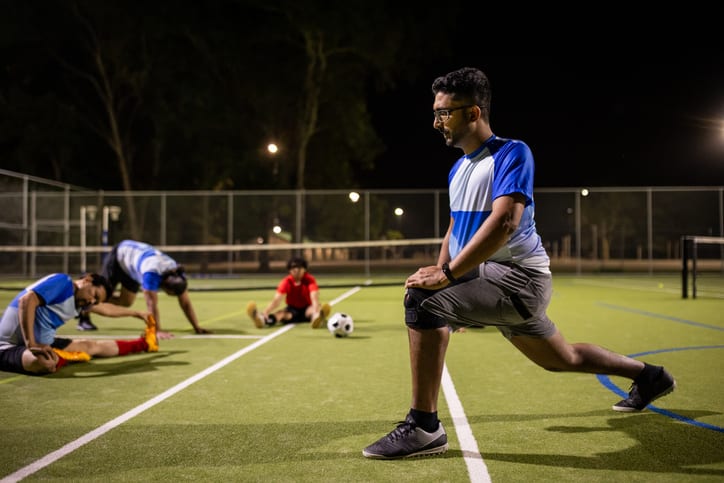
"Recreational athletes should train their whole body but for certain should not miss strengthening the hip and leg muscles. Muscle injuries account for the most injuries sustained across all levels, with hamstrings being the most suspectable," Dr. Henning advises. "A good lower body routine would include squats and lunges. Lunges should be done in a manner that would load the groin and muscles along the outside of the hip. Moving in diagonal or lateral directions while lunging is helpful in this regard. Calf muscles, in particular the soleus muscle, should be targeted."
What are some common injuries associated with soccer?
Muscle strains are the most common — including the hamstring, quad, adductor (the muscle group in your thigh that stabilizes your hip when you run, walk or change directions) and calf," says Obert. "Knee ligament sprains are the most burdensome and associated with the most time away from the game."
I have knee pain when I play, but it subsides when I rest. Should I just ice it?
"There are likely more treatments that can help besides ice," says Obert. "Motion is lotion and normally more helpful to an injury cycle (because movement helps keeps joints and ligaments flexible). And it's also important to see a sports medicine specialist, who can provide expert guidance and perscribe appropriate treatment."
How much rest should I include in my schedule?
"It depends on how you are defining rest. If you mean sleep, then the U.S. Centers for Disease Control and Prevention recommends 7-9 hours per night for people age 18 to 64, and 8-10 hours for teens who are 13-17 years old," says Dr. Henning. "If you mean time away from playing then most recreational athletes generally have enough time away from playing given their other life demands. What they typically do not spend enough time doing is preparing their body to play sports. Any athlete regardless of age or sport involvement level should exercise to be able to play sports rather than relying on playing sports to maintain fitness. Per American College of Sports Medicine, aerobic exercise should involve 30-60 minutes of moderate intensity activity 5 days per week, and strengthening 8-10 muscle groups on non-consecutive days at least 2 days per week."
We may not all be destined for the World Cup, but what's one recovery habit elite players prioritize that everyone can adopt?
"SLEEP! Sleep is our best recovery tool and helps with cognitive function as well," says Obert. "Also, it’s free!"
Learn more and find a physician or advanced practice clinician (APC)
Do you or a loved one need to consult about a spine or orthopedic surgery or a joint replacement? Experts at the Swedish Orthopedic Institute (SOI) can help. To make an appointment with an expert at Providence Swedish Orthopedics, call 206-386-6171. You can also visit our website to learn more about the services avaialble at Swedish Spine, Sports and Musculoskeletal Medicine.
Whether you require an in-person visit or want to consult a doctor virtually, you have options. Contact Swedish Primary Care to schedule an appointment with a primary care provider. You can also connect virtually with your provider to review your symptoms, provide instruction and follow up as needed. And with Swedish ExpressCare Virtual you can receive treatment in minutes for common conditions such as colds, flu, urinary tract infections and more. You can use our provider directory to find a specialist or primary care physician near you.
Information for patients and visitors
Additional resources
Learn how one Swedish doc keeps pro rugby players in championship form
Inside the World of Ultimate Frisbee with a team USA physician
Step into comfort: Understanding knee replacement surgery
Dink, rally and repeat: How to play pickleball without the pain
Guys, take it from the coach of Seattle Sounders FC, health screenings can help you
This information is not intended as a substitute for professional medical care. Always follow your healthcare professional's instructions.
Follow us on Facebook, Instagram and X.
The Providence app offers world-class health care with human connection