"I want to keep him." Swedish Issaquah care teams help a determined mom and her baby beat the odds.
[6 min read]
In this article:
- Amanda Williams was pregnant with her second child she came face-to-face with the terrifying possibility of losing her baby.
- Prioritizing her health and safety, Williams' physicians explained her options and the low likelihood of the baby's survival, but she was determined to carry her pregnancy.
- Angie Swanson, William's mother, recounts how the loving dedication of Providence Swedish care teams helped soothe the family's fears.
- Read more to learn how Angie Swanson are making music together and how philanthropy supports compassionate, expert care at Providence Swedish.
After a difficult delivery with her son Grayson, Amanda Williams and her husband decided having one child would be enough. But as Grayson entered elementary school, he pleaded for a sibling.
Amanda became pregnant with a boy and was 16 weeks along when, one January morning, everything changed. While lifting a vacuum out of a swimming pool, Amanda felt something shift inside of her and began bleeding with a frightening intensity.
Williams called her husband, who drove her to the emergency room at Providence Swedish’s Issaquah campus, less than 15 minutes from their home. Two nurses came to meet them at the car, arriving with blankets to give Amanda a measure of privacy.
The last thing she remembers is being rushed into the bright lights of the operating suite, where the surgical team packed her uterus with gauze to halt the blood loss. The broader surgical team accompanied Amanda when she was wheeled back to her room for recovery.
“It felt big and weighty,” says Amanda’s mother, Angie Swanson. Her daughter was stable, but the hardest part was the conversation that came next.
The doctors explained that Williams had experienced a complete placenta previa, a pregnancy complication where the placenta develops low in the uterus and covers the cervix. The placenta in this position can cause severe bleeding — and block the infant’s passageway through the cervix at birth. Williams had lost nearly half her blood supply. Miscarriage was the most likely outcome given the circumstances. The care team viewed her health and safety as their top priority.
“Her older boy needed her, and her life was in danger,” says Swanson.
But Christina E. Tolley, M.D., the OB/GYN specialist on duty, wanted to wait until Amanda was awake so she could take part in the conversation about how to proceed. Dr. Tolley and the other specialists laid out her options, the potential outcomes, and the low likelihood that her infant would survive.
“I want to keep him,” Williams pleaded.
Watching and waiting
Over the next hours, the family gathered to be with Williams. Her care team moved forward at a measured pace so she felt supported and not rushed. She appreciated the care team’s solemn, respectful approach as the family processed the situation’s emotional weight.
As Swanson puts it, “They explained. They waited. They prepped. They explained again. They were just so kind.”
The surgical team removed the gauze packing that had stanched Williams' bleeding, ready to transport her to Providence Swedish First Hill for urgent specialty care if necessary. Then, everyone waited. Nurses monitored her vital signs and confirmed the bleeding did not begin again. She remained stable overnight.
In the morning, an ultrasound delivered wonderful news: Williams' baby boy appeared healthy and active, despite all the blood loss. Angie remembers one doctor telling her daughter that in 35 years of practice, she was only the second patient he’d seen to maintain a pregnancy after this type of emergency. That ultrasound was the first time Swanson saw her grandson.
Afterward, she left her daughter’s second-floor hospital room to collect herself. The previous night, she’d faced a likelihood her unborn grandson would not survive. That morning she saw her first glimpse of him, “happy and bouncing around.” As she sat in the second-floor lounge, she heard the unexpected sound of piano music. Swedish Issaquah has a baby grand piano — a generous gift from a donor when the campus opened in 2011. Its music soothed her in a moment of emotional and physical exhaustion.
“I remember being so thankful for that momentary diversion,” Swanson says.
The moment of crisis was over, but Williams needed to carry her baby to term. She spent five days at Providence Swedish First Hill for monitoring, due to the high-risk nature of her pregnancy. Her nurses at Issaquah helped make the transition as smooth as possible, Amanda remembers.
She knew she was supposed to avoid stress but worried constantly that every shift or twinge within her body could spell more complications: “Every morning, really every second, it was the fear that I might feel anything different.” Her nurses devised a system to keep anxiety at bay. “Any time I started crying or was feeling emotional, they would come in and check the baby’s heart rate.”
Seeing proof her baby was still doing well helped her stay calm and offered invaluable emotional support. After five days, Williams was able to go home. She went on medical leave from her job as a first-grade teacher to recover for the remainder of her pregnancy. Her OB/GYN, Ye Ji Choi, M.D., laid out a series of milestones. If she got to 32 weeks, she would be able to deliver at Swedish Issaquah rather than the high-acuity care center at First Hill. This was her goal.
“She wanted to be with those nurses,” says Swanson.
Williams reached 37 weeks when Dr. Choi determined it was time to deliver. She arrived at Issaquah’s childbirth center for her C-section and found an operating suite full of familiar faces who supported her through her journey.
Dr. Tolley, the OB/GYN on duty when she first arrived at the emergency room, requested to be in the surgery with Dr. Choi. The nurses who cared for her during the uncertainty and fear of her first visit also arranged their schedules to be present and available to assist.
“I could not have done it without them,” says Williams.
Warren Williams was born on June 3, 2025. While his mother recovered from surgery, he spent five days in the neonatal intensive care unit (NICU), receiving advanced care to remove fluid from his lungs. Williams was especially grateful for the NICU’s semi-private rooms, which made it easier to spend time with her son once she was discharged.
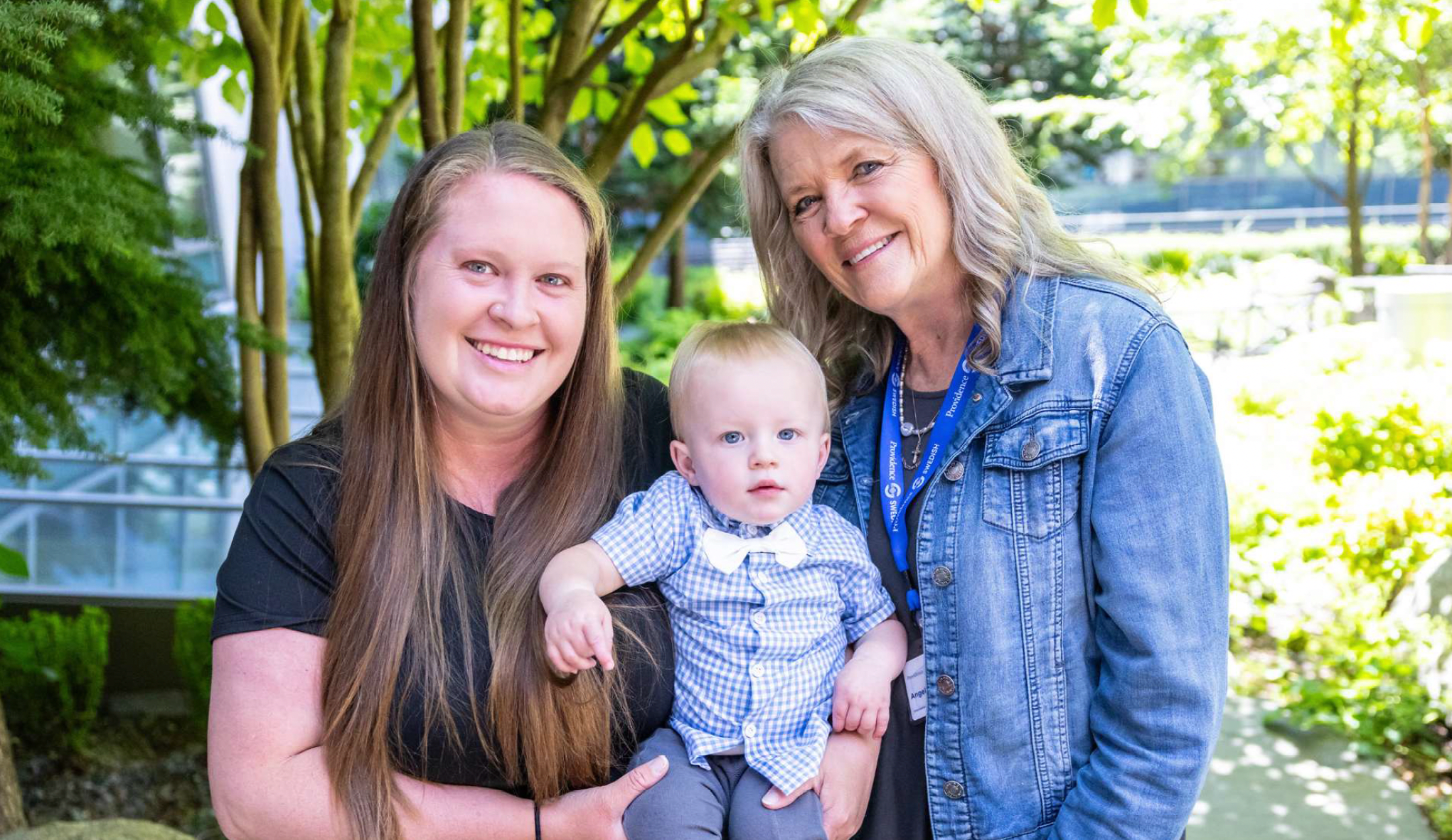
Then, at last, she was able to bring home a happy, healthy baby. She recounts this harrowing, ultimately happy story while Warren, smiley and energetic at 12 months old, explores and squirms and plays with his older brother. Now 8 years old, Grayson reports being an older brother is just as wonderful as he imagined.
Paying the music forward
Warren is home and healthy, but the family’s journey with Swedish Issaquah has continued. Angie, who sings and performs in a band, did not forget the piano music that soothed her during those difficult hours. She completed the training required to volunteer at Providence Swedish and donates her time playing piano every week.
“Most of my volunteers have some sort of connection to Swedish,” says Kelly Huber, volunteer services manager for the campus. “She recognizes the power of music and she’s an amazing pianist.”
The Issaquah campus itself was designed to support this type of transformational patient care. It’s filled with recycled materials, retail shops, the restaurant-style Café 1910, and a five-story atrium that lets in light and carries music to the upper floors.
“Maybe as a patient you don’t notice them specifically, but you recognize it makes a difference,” Huber says.
Patients and visitors on a Thursday may hear the strains of “Forever Young” or “Only Fools Fall in Love” floating through the sunlit concourse. It’s probably Angie Swanson at the keys. When she plays, she brings a framed photograph of Warren to put atop the piano.
“If people ask me about it,” she says, “I tell them — they saved my grandson.”
Learn more and find physician or advanced practice clinician care (APC)
Swedish has three birth centers — First Hill, Issaquah and Edmonds — making it convenient for people who live or work in the Seattle, Eastside and North End areas. Swedish patients can take classes, meet other families, get help with lactation and go for new parents and well-baby checkups at The Lytle Center for Pregnancy & Newborns at our First Hill birth center. You can also get expert advice there and help with wellness. Visit our website to learn more about midwives at Swedish and how they can partner with you to create the most personalized birthing experience possible.
If you need a gynecologist, women's health specialist or primary care doctor, Swedish is here for you. Whether you require an in-person visit or want to consult a doctor virtually, you have options. Swedish Virtual Care connects you face-to-face with a nurse practitioner who can review your symptoms, provide instruction and follow up as needed. If you need to find a doctor, you can use our provider directory
And if you have questions or concerns about an older child’s wellness, Swedish Pediatrics is here to help. Call today to schedule a visit.
About the Swedish Foundation
Your generous gift helps support a healthy tomorrow for everyone in every community we serve. Learn about more ways to give to the Swedish Foundation or make a direct donation online at swedishfoundation.org. You can also contact the Foundation at 206-368-2738 or email foundation@swedish.org. Thank you for helping us shape the future of healthcare. We can’t do it without you.
Information for patients and visitors
The unexpected sweetness of pregnancy and new parenthood
Is a C-section the right choice for you?
Why the Vitamin K shot is a vital part of your newborn's safety net