A life saved at the gym: How quick action, CPR and AED made the difference
[3 min read]
In this article:
- Fortunately, there was a doctor in the house when Edmonds pickleballer Gary Dangleis collapsed on the court.
- Providence Swedish Cardiologist Neil Siecke, M.D., immediately began chest compressions, while an off-duty firefighter who was also at the gym searched out an automated external defibrillator (AED).
- The incident highlights how a clear “chain of care” in an emergency can make survival possible: immediate bystander CPR and calling 911, rapid use of an AED to shock the heart, and advanced care in the hospital.
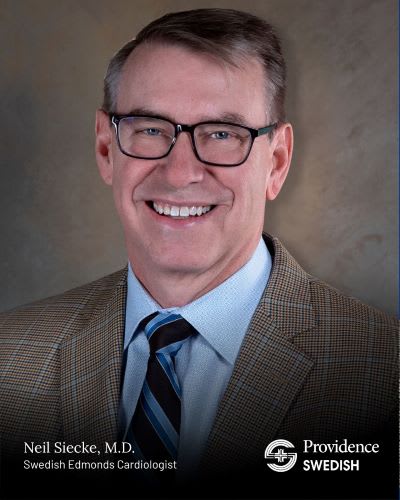
For Neil Siecke, M.D., a cardiologist at Providence Swedish in Edmonds, cardiac arrests usually happen in a hospital. But during a routine workout at the Edmonds Bay Club, his medical training was suddenly needed on the pickelball court.
A man nearby was unconscious, not breathing and turning purple. He was in cardiac arrest.
“The moment I saw him, I knew we didn’t have time to wait,” Dr. Siecke said. “My training just kicked in.”
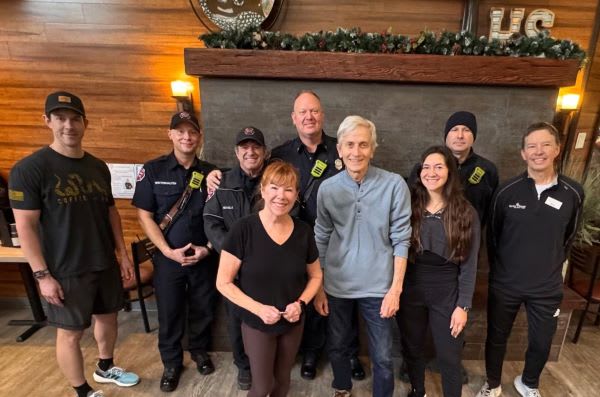
Gary Dangleis, a 73-year-old Edmonds resident, was playing pickleball when he collapsed. (Dangleis, in a gray sweatshirt in photo above, is shown with family members and local firefighters. Photo courtesy South County Fire)
Dr. Siecke immediately began chest compressions and cardiopulmonary resuscitation (CPR). An off-duty firefighter who was also at the gym rushed to locate the facility’s automated external defibrillator (AED). Once the pads were applied, the two worked together to deliver a shock that restored Dangleis’ heartbeat before paramedics arrived. Their swift action in those critical minutes stabilized him so he could be safely transported to Providence Swedish Edmonds.
 There, Dangleis said he received excellent care from a strong team of physicians and medical staff. He underwent angioplasty with placement of a stent and is now doing cardiac rehabilitation as part of his recovery.
“My doctor told me when someone becomes unconscious, you really only have a couple of minutes to start CPR and act fast,” said Dangleis. “I’m beyond grateful and can’t appreciate enough how fortunate I was that this happened with the people who were there and how things transpired.”
Although Dr. Siecke routinely treats cardiac emergencies inside the hospital, this situation was different.“In the hospital, you have monitors, a team and a lot of information,” he said. “Here, I didn’t know who he was or what his medical history was. It was just about recognizing cardiac arrest and acting immediately.”
Dr. Siecke describes a clear “chain of care” that makes survival possible: immediate bystander CPR and calling 911, rapid use of an AED to shock the heart, and advanced care in the hospital.
“Without those first two steps, the rest doesn’t matter,” he said. He emphasizes that CPR can double a person’s chances of survival, and anyone can do it.
Following the incident, Dr. Siecke met with the gym manager to review what worked and what could be improved. The gym responded quickly: AEDs are now clearly visible throughout the facility, and the club began offering free CPR and AED training to its members and staff.
Dr. Siecke encourages everyone to prepare, whether through formal training or basic education.
“It’s easy to take a CPR and AED class, and if you can’t, watch a video online,” he said. “Remember, the song ‘Staying Alive’ – 120 beats per minute. Push hard and fast in the center of the chest. That’s the most important thing anyone can do.”
A community saving lives
This life-saving moment also reflects a broader success story in Southwest Snohomish County, which has some of the nation’s best outcomes for out-of-hospital cardiac arrest thanks to a strong focus on high-performance CPR and community preparedness.
New data shows South County Fire’s cardiac arrest survival rate is 71 percent, nearly double the national average, making the area one of the safest places in the U.S. to experience cardiac arrest.
“When communities invest in training, AED access and people feeling confident enough to act, lives are saved,” Dr. Siecke said. “You don’t have to be a cardiologist to save someone’s life. Doing something is always better than doing nothing.”
Learn more and find a physician or advanced practice clinician (APC)
The team of specialists at the Providence Swedish Heart & Vascular Institute has access to the latest treatments and technology and the expertise to know how to use it safely and effectively. Call 206-320-4100 to learn more about the vascular care we offer.
Whether you require an in-person visit or want to consult a doctor virtually, you have options. Contact Swedish Primary Care to schedule an appointment with a primary care physician. You can also connect virtually with your doctor to review your symptoms, provide instruction and follow up as needed. And with Swedish ExpressCare Virtual, you can receive treatment in minutes for common conditions such as colds, flu, urinary tract infections and more. You can use our provider directory to find a specialist or primary care physician near you.
Information for patients and visitors
Additional resources
A doctor's persistence and a daughter's love saved this Seattle dad's life
Hypertension is a silent and deadly threatThe Providence Swedish Heart & Vascular Institute is transforming cardiovascular care
Are you at risk for heart disease? Take this short quiz to learn more.
This information is not intended as a substitute for professional medical care. Always follow your healthcare professional's instructions.
The Providence app offers world-class health care with human connection